Framing, subfloor and wall cavities
Structural Drying in Duluth, GA
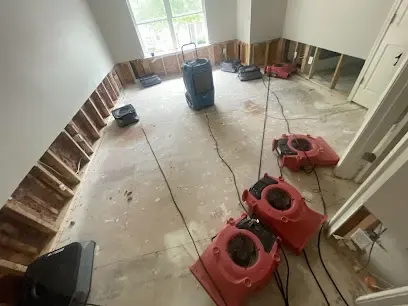
Surface dry is not the same as dry. The drying team maps moisture in framing, subfloor and wall cavities, sizes air movers and dehumidifiers to each room, and leaves the equipment until readings meet the drying goal.
(888) 532-4616Get the Duluth drying started today- IICRC S500 drying standard
- LGR dehumidification
- Daily drying logs
Do this first
First steps for structural drying in Duluth
- 1
Stop the water source
Drying cannot start until no new water is coming in.
- 2
Get standing water out
Extraction comes before air movers. See water extraction.
- 3
Keep the house closed
In humid weather, open windows let moist outside air slow the drying.
- 4
Leave the equipment running
Turning air movers and dehumidifiers off overnight adds days to the job.
How the work is done
How the restoration team handles structural drying
Rapid local response
The response team dispatches 24/7 across Duluth and Gwinnett County, with rapid local response on active water.
IICRC S500 drying standard
IICRC S500 is the industry drying standard. Structural drying, not just surface drying, with equipment sized to the room.
Claim-ready documentation
Moisture maps, daily drying logs and timestamped photos taken before any demolition go into the claim file.
Gwinnett water experts
Attic air handlers, polybutylene supply lines, daylight basements and red clay: the crews know how water moves in a Duluth house.
Typical cost ranges
What does structural drying cost in Duluth, GA?
Structural drying in Duluth, GA typically runs $1,000 to $6,000. The cost is driven by the class of the loss (how much surface area and how dense the wet materials are), how many air movers and dehumidifiers the rooms need, and how many days the equipment runs.
Class 1 or 2, one area
$1,000 to $2,500
- A few air movers
- One LGR dehumidifier
- Three days of readings
Class 3, walls and ceilings
$2,500 to $4,500
- Cavity drying with injectors
- Several dehumidifiers
- Four to five days
Class 4, dense materials
$4,500 to $6,000+
- Hardwood, plaster, concrete
- Desiccant dehumidifiers
- Extended monitoring
Ranges are typical, not quotes. For a closer planning number use the water damage cost calculator; the restoration contractor who responds sets the real scope after the walkthrough.
Structural drying is the part of a water loss that decides whether the problem is really over. Water soaks into studs, subfloor, drywall, hardwood and concrete, and those materials look dry on the surface long before they are dry inside. IICRC S500 is the industry drying standard, and it treats drying as a measured process, not a number of days.
How the drying plan is set
The tech who does the walkthrough maps moisture with pinless and pin meters and thermal imaging, then sets the category and class of the loss. Class 1 through 4 describes how much wet surface there is and how dense the materials are, and that sets how many air movers and dehumidifiers a room needs.
- Class 1 and 2: part of a room or a whole room, mostly carpet and drywall.
- Class 3: walls, ceilings and insulation soaked, usually from above.
- Class 4: dense materials like hardwood, plaster and concrete that need low humidity and time, often with desiccant dehumidifiers.
Air movers, dehumidifiers and readings
Air movers pull moisture out of wet surfaces into the air, and LGR (low grain refrigerant) dehumidifiers pull it back out of the air. In a humid Duluth summer the dehumidifiers carry a heavy load, so the house stays closed while they run. The drying team takes readings every day and compares them with a dry reference material in an unaffected part of the same house. Equipment comes out when the wet material is within 2 to 4 points of that reference.
Why the logs matter
Daily psychrometric readings and moisture logs show the insurer the job was dried to a standard and not just until it looked dry. EPA moisture guidance explains the link between lingering moisture and mold, and UGA Cooperative Extension covers humidity in Georgia homes. Drying starts after water extraction and applies to every loss, from burst pipes to flooded basements.
The order of work
How structural drying is handled in Duluth
- 1
Map the moisture
The tech who does the walkthrough maps moisture with pinless meters and thermal imaging, then sets the category and class of the loss before any equipment goes down.
- 2
Extract
The extraction crew pulls standing water with truck-mounted extraction so it leaves the house instead of wicking into the next room.
- 3
Dry the structure
The drying team sets air movers to each room's evaporation load and runs LGR dehumidifiers, which matters in a humid Georgia summer.
- 4
Verify dry
Crews log readings daily and pull equipment only when wet materials sit within 2 to 4 points of a dry reference material.
Areas served
Covered across Duluth and Gwinnett County
The Duluth restoration team works the whole city, from the Town Green and Pleasant Hill to Sugarloaf and the Chattahoochee side, and out to Suwanee, Johns Creek, Berkeley Lake, Peachtree Corners, Norcross and Lawrenceville.
Duluth ZIP codes 30095, 30096, 30097, 30098 and 30099 are all covered.
See every neighborhood and ZIP codeRelated
Related water damage services in Duluth
Answers
Structural drying questions, answered
What is the IICRC S500 standard?
It is the industry standard for professional water damage restoration. It covers how losses are classified by category and class, how drying is planned and measured, and when materials should be removed instead of dried.
How do crews know when the structure is dry?
They compare daily meter readings of the wet materials with a dry reference material of the same type in an unaffected part of the house. When the wet material reads within 2 to 4 points of the reference, it has reached the drying goal.
Why can't I open the windows to help it dry?
In Duluth's humid weather, outside air often carries more moisture than the air the dehumidifiers are producing. Opening windows can slow the drying down.
Why is the equipment so loud and warm?
Air movers push a lot of air and LGR dehumidifiers release warm, dry air as they work. The warmth actually helps evaporation. The noise ends when the equipment comes out.
Can structural drying save my hardwood floors?
Often, yes. Floor drying mats and dehumidification can pull moisture out of hardwood, which is a Class 4 material. Some cupping may remain and settle out, or need refinishing.
How long does structural drying take?
A contained Class 1 or 2 loss usually dries in three to five days. Class 3 and 4 losses with ceilings, hardwood, plaster or concrete take longer.
Emergency water removal, Duluth, GA
Wet walls or floors in your Duluth home?
Equipment stays until the readings say dry. The drying team works across Duluth and Gwinnett County every day of the year.